
Developer Tools
Best AI Agent Platforms for Developers
A developer-focused framework for choosing AI agent platforms by orchestration, tools, memory, security, and production observability.
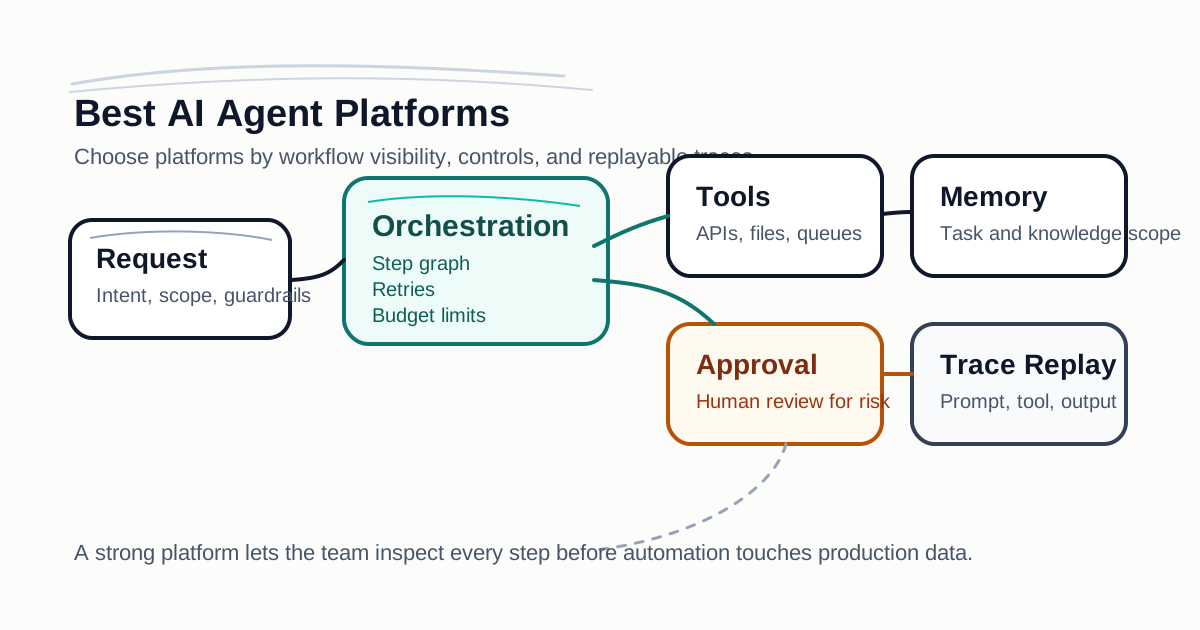
AI agent platforms are useful when a workflow needs planning, tool use, retrieval, memory, and stateful execution. They are not always the right answer. A simple prompt, queue worker, or deterministic script is often easier to operate. The best platform is the one that lets your team ship a reliable workflow without hiding the parts you must debug later.
Core Capabilities To Inspect
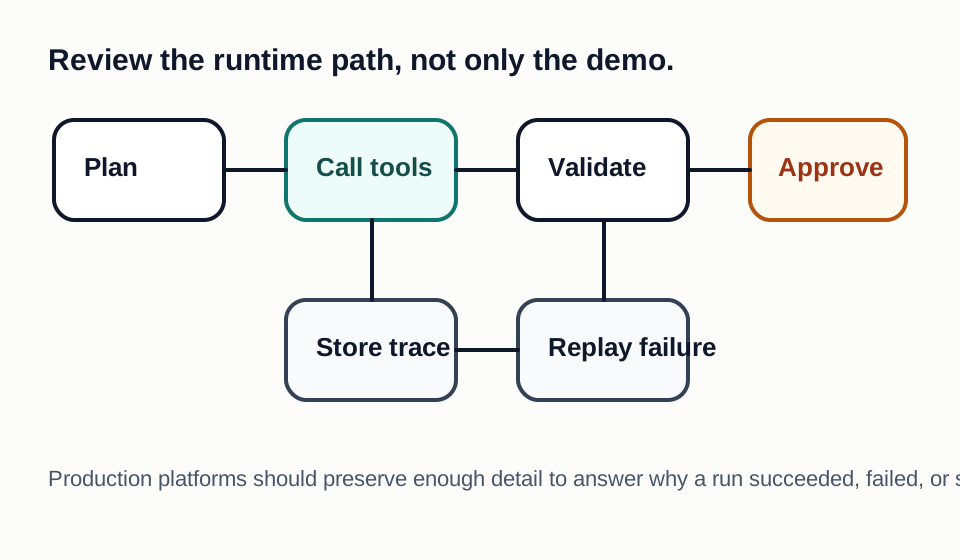
Agent orchestration should be explicit. You need to know which step called which tool, what input was passed, which model was used, and how the platform recovered from failure. If an agent platform only shows a polished chat transcript, it may be difficult to debug in production.
Tool integration is the second priority. A useful developer platform should connect to APIs, internal services, databases, file systems, queues, and approval steps without forcing every action through brittle browser automation. For higher-risk actions, the platform should support human review before execution.
Memory and retrieval should be scoped. Global memory can create privacy and relevance problems. Production agents usually need task memory, user memory, project memory, and searchable knowledge stores with clear boundaries.
Platform Selection Checklist
| Requirement | Strong Signal | Weak Signal |
|---|---|---|
| Workflow design | Versioned steps, retries, branching, approvals | One large hidden prompt |
| Tool use | Typed inputs, permissions, logs | Free-form actions with little auditing |
| Observability | Trace timeline, model calls, token cost, error causes | Only aggregate usage charts |
| Deployment | Environment separation and rollback | Manual edits in production |
| Governance | Access control and policy enforcement | Shared keys and informal permissions |
| Evaluation | Test sets and regression reports | Demo-only examples |
When To Build Instead
Build your own lightweight agent runner when the workflow is narrow, deterministic, and deeply tied to internal systems. A code review bot, invoice classifier, or support triage assistant may not need a large platform if it has only three steps and clear success criteria.
Buy or adopt a platform when the workflow changes often, needs multiple tools, requires non-engineers to inspect runs, or must support several teams. The operational interface is often the difference between a demo and a durable system.
Production Risks
Agent systems can fail silently when retrieval returns weak context, when tool outputs are partial, or when model responses look plausible but skip required checks. Guardrails should include structured outputs, validation, timeouts, rate limits, audit logs, and explicit refusal paths for unsafe actions.
Shortlist Criteria
Build a shortlist around the workflow, not around the platform category. If the agent will update internal records, prioritize permission boundaries, approval gates, and audit logs. If the agent will answer customer questions, prioritize retrieval quality, citation support, evaluation, and fallback behavior. If the agent will operate developer workflows, prioritize repository integrations, CI visibility, trace replay, and environment separation.
A strong platform should let engineers see every important step in a run: the user request, retrieved context, model calls, tool inputs, tool outputs, validation results, retries, and final action. A weak platform hides these details behind a generic chat interface. That may be acceptable for a prototype, but it becomes risky when the agent touches production data or external systems.
Evaluation Workflow
Run a structured evaluation before buying. Start with ten ordinary cases, five edge cases, and five failure cases. Ordinary cases show whether the platform can deliver the expected workflow. Edge cases show whether it can handle missing fields, ambiguous intent, stale data, conflicting instructions, or partial tool failures. Failure cases show whether the system stops safely when it should not proceed.
Record completion rate, number of model calls, tool-call errors, human approvals, total latency, and cost per successful run. Also review trace quality. If a failed run cannot be explained from the platform logs, the team will struggle to maintain the workflow after launch. Agent platforms should be judged by operability as much as by model quality.
Build vs Buy Decision
Buy a platform when multiple teams need reusable orchestration, non-engineers need to inspect runs, workflows change often, or governance is more expensive than the subscription. Build internally when the workflow is narrow, the steps are stable, and the system must live deeply inside private infrastructure.
The build path is not free. Internal agent runners need prompt management, tool schemas, retries, traces, test sets, budget controls, secrets handling, permission checks, and deployment workflows. A small script can become a platform accidentally. The buy path has different risks: vendor lock-in, pricing changes, limited customization, and dependence on external uptime. The best decision comes from comparing the full operating model, not the demo.
Security And Governance
Agent governance should be designed before production access is granted. Require scoped credentials, least-privilege tool access, environment separation, approval for irreversible actions, and logs that security teams can review. Avoid shared API keys and broad service accounts. If an agent can send email, change a database, open a pull request, trigger a deployment, or modify a customer record, it needs stronger controls than a normal chatbot.
Bottom Line
Choose an AI agent platform only after mapping the workflow, failure modes, data boundaries, and human approval points. The best platform is not the flashiest demo. It is the one your team can observe, test, govern, and roll back.
Decision Checklist For Best AI Agent Platforms for Developers
Use this guide as a decision filter before a sales call, trial, or migration plan. For Best AI Agent Platforms for Developers, the practical question is whether the topic connects best AI agent platforms, AI agents, developer automation to a measurable workflow outcome. A good decision should improve delivery speed, quality, cost control, or operational confidence without creating hidden review, security, or migration work.
- The platform reduces review cycles, debugging time, release risk, or operational uncertainty for a defined engineering team.
- Usage, traces, errors, and cost can be attributed to projects or workflows without spreadsheet cleanup.
- The tool fits current repositories, issue trackers, CI pipelines, and incident workflows with limited custom glue code.
Pilot Plan
A useful pilot is small enough to finish quickly but realistic enough to expose integration, data, workflow, and pricing issues. Avoid demo-only tests. The trial should use real tasks, real constraints, and a baseline from the current process so the team can decide with evidence instead of impressions.
- Select one repository or production workflow where the current pain is already visible.
- Measure baseline cycle time, escaped defects, alert noise, or manual review effort before enabling the tool.
- Ask engineers to record where the tool helped, where it interrupted flow, and where output needed rework.
Metrics To Track
Track metrics that connect Best AI Agent Platforms for Developers to outcomes a budget owner and an engineering owner can both understand. A tool can look impressive in a demo and still fail if usage is low, quality is uneven, or the cost model changes under real workload volume.
- Cycle time from task start to accepted change or resolved incident.
- Number of manual handoffs, review comments, escaped defects, or repeated debugging steps.
- Monthly cost by active team, repository, project, or production workflow.
Budget And Risk Review
Commercially useful AI tooling decisions should include the subscription or API price, but they should also include support load, review time, observability, privacy controls, switching cost, and the cost of wrong or low-quality output. Treat the first estimate as a working model and update it with production evidence.
- Validate SSO, audit logs, role-based permissions, retention settings, and export behavior before annual billing.
- Check whether pricing is tied to seats, events, stored traces, indexed code, or premium model calls.
- Confirm the team can continue operating if the vendor has an outage or changes pricing.
Review developer-tool purchases after two sprints and after one release. Keep the tool only if the measured workflow gain is visible to both engineers and the budget owner.
Editorial note
AI Jupyter writes independent guides for technical readers. Product details, pricing, and feature names can change, so readers should verify commercial terms on the official vendor site before buying.
Reviewed by the AI Jupyter Editorial Team.