
The AI Agent Platform Landscape: Enterprise Platforms, Low-Code Builders, and Developer Frameworks
A practical guide to today’s AI agent platform landscape, covering enterprise platforms, low-code agent builders, open-source frameworks, automation tools, and developer-first orchestration stacks.
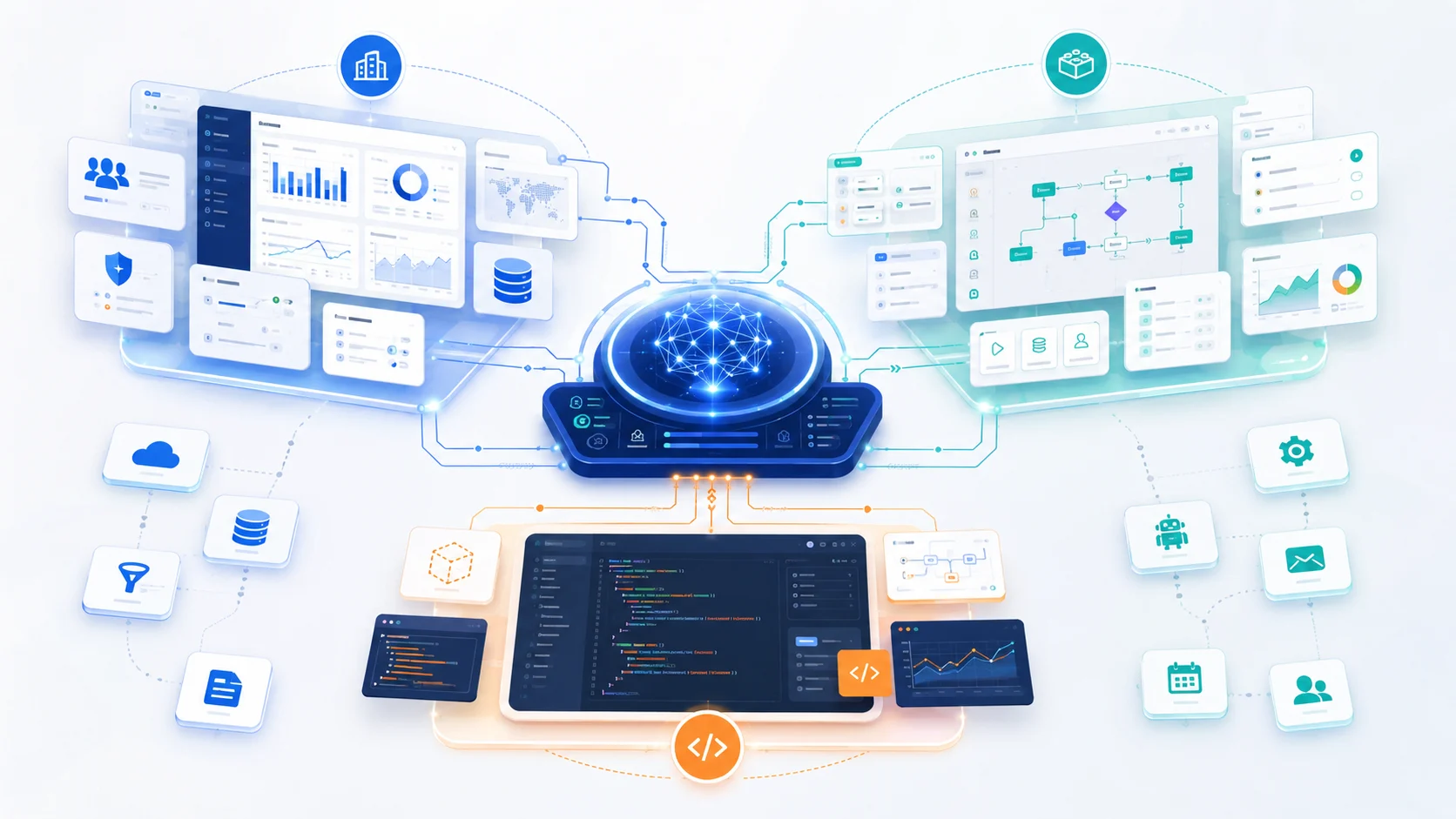
AI agents are moving from demos to real workflows.
A few years ago, most AI work was about prompt engineering: writing better instructions for a model. Today, the question is bigger:
Which platform should you use to build, run, monitor, and improve AI agents?
That question matters because the AI agent ecosystem is no longer one category. It now includes enterprise platforms, cloud agent services, low-code automation builders, open-source agent frameworks, coding agents, customer support agents, and workflow orchestration tools.
This article maps the current AI agent platform landscape and explains how to choose the right platform for different use cases.
What Is an AI Agent Platform?
An AI agent platform helps teams build systems that can reason, call tools, use data, complete tasks, and sometimes continue working across multiple steps.
A simple chatbot answers questions.
An AI agent can often:
- read context
- choose a tool
- call an API
- search documents
- inspect a database
- run code
- update a workflow
- ask for approval
- retry after failure
- hand work to another agent
- produce a final result
The platform around the agent matters because real agent systems need more than a model. They need memory, tools, permissions, evaluation, observability, human approval, deployment, and cost control.
The AI Agent Platform Landscape
The market can be divided into five major groups:
| Category | Best For | Examples |
|---|---|---|
| Enterprise agent platforms | Large organizations, CRM, IT, support, operations | OpenAI AgentKit, Microsoft Copilot Studio, Google Vertex AI Agent Builder, AWS Bedrock Agents, Salesforce Agentforce, ServiceNow, IBM watsonx Orchestrate, UiPath |
| Low-code and no-code builders | Business users, automation teams, fast prototypes | Dify, n8n, Zapier Agents, Make, Relevance AI, Lindy, Gumloop, Flowise, Langflow |
| Developer frameworks | Engineers building custom agents | LangGraph, CrewAI, OpenAI Agents SDK, Google ADK, Microsoft Agent Framework, LlamaIndex, Pydantic AI, Haystack |
| Conversational and support agent platforms | Chatbots, customer support, voice agents | Botpress, Voiceflow, Rasa, Intercom Fin, Zendesk AI agents |
| Specialized agent tools | Coding, data, analytics, internal workflows | Databricks Mosaic AI, Snowflake Cortex Agents, Retool Agents, Dust, Vellum, Wordware, Stack AI |
The best platform depends on what kind of agent you are building.
Enterprise AI Agent Platforms
Enterprise platforms focus on security, governance, integration, deployment, and business workflows. They are usually the best choice when agents need to connect with internal systems such as CRM, ERP, ITSM, data warehouses, or customer support tools.
OpenAI AgentKit, Agent Builder, and Agents SDK
OpenAI now offers a broader agent development stack with AgentKit, Agent Builder, and the Agents SDK.
The important idea is that OpenAI is no longer only a model API provider. It is also building the infrastructure for creating multi-step agents, connecting tools, designing workflows, and deploying agentic applications.
OpenAI Agent Builder is useful for teams that want a visual way to design agent workflows, while the Agents SDK gives developers more control in code.
Official link: OpenAI Agent Builder
Microsoft Copilot Studio and Microsoft Agent Framework
Microsoft has one of the strongest enterprise positions because it already owns the productivity layer: Microsoft 365, Teams, Dynamics, Power Platform, Azure, and GitHub.
Microsoft Copilot Studio is aimed at building business agents with low-code tools. Microsoft Agent Framework is more developer-oriented and is becoming the long-term framework direction for building agentic applications in the Microsoft ecosystem.
Microsoft is especially strong for companies already using Microsoft 365, Azure, Dynamics, SharePoint, Power Automate, or Teams.
Official links: Microsoft Copilot Studio, Microsoft Agent Framework
Google Vertex AI Agent Builder, Gemini Enterprise, and ADK
Google’s agent stack includes Vertex AI Agent Builder, Gemini Enterprise Agent Platform, and the Agent Development Kit.
Google is strong in search, cloud infrastructure, data, multimodal models, and enterprise AI deployment. Its Agent Development Kit is useful for developers who want to build more customized agents, while Vertex AI Agent Builder and Gemini Enterprise focus more on enterprise deployment and integration.
Official links: Google Gemini Enterprise Agent Platform, Google ADK
Amazon Bedrock Agents and AgentCore
AWS is important because many production systems already run on AWS.
Amazon Bedrock Agents help developers build agents that can use foundation models, call tools, interact with data, and complete business tasks. AgentCore adds more infrastructure for running and managing agents in production.
AWS is a strong choice for companies already using AWS identity, databases, Lambda, S3, enterprise networking, and cloud security tooling.
Official link: Amazon Bedrock Agents
Salesforce Agentforce
Salesforce Agentforce is one of the most important enterprise AI agent platforms because Salesforce owns the customer data and CRM workflow layer for many companies.
Agentforce focuses on agents for sales, service, marketing, commerce, and customer operations. For teams already using Salesforce, Agentforce can be more practical than building an agent stack from scratch.
Official link: Salesforce Agentforce
ServiceNow AI Agent Studio
ServiceNow is strong in IT, HR, operations, and enterprise workflow management. AI Agent Studio is designed for building agents inside ServiceNow workflows.
It is especially relevant for IT service management, ticket handling, internal support, workflow routing, and enterprise process automation.
Official link: ServiceNow AI Agent Studio
IBM watsonx Orchestrate
IBM watsonx Orchestrate is aimed at enterprise productivity and workflow automation. IBM’s strength is enterprise governance, compliance, hybrid cloud, and integration with business systems.
It is a better fit for large organizations than for individual developers.
Official link: IBM watsonx Orchestrate
UiPath Agent Builder and Agentic Automation
UiPath is important because RPA and agents are converging.
Traditional RPA automates structured workflows. AI agents add reasoning, language understanding, and flexible decision-making. UiPath’s agentic automation direction is built around combining deterministic automation with AI-driven decisions.
This is useful for finance, operations, back-office workflows, document processing, and enterprise automation.
Official link: UiPath Agent Builder
Other Enterprise Platforms to Watch
The enterprise agent category is expanding quickly. Important platforms include:
- Oracle AI Agent Studio
- SAP Joule Studio
- Databricks Mosaic AI Agent Framework
- Snowflake Cortex Agents
- Atlassian Rovo Agents
- Adobe Experience Platform Agent Orchestrator
- HubSpot Breeze Agents
- Workday Agent System of Record
These platforms matter because AI agents will often live inside existing business systems, not in isolated chat windows.
Low-Code and No-Code AI Agent Builders
Low-code and no-code platforms are popular because most companies do not want every agent workflow to require a full engineering team.
These tools are useful for:
- internal automation
- customer support workflows
- lead qualification
- document processing
- research assistants
- sales operations
- marketing workflows
- reporting
- tool-calling agents
- lightweight RAG systems
Dify
Dify is one of the most popular open-source platforms for building LLM applications, RAG workflows, and agentic systems.
It is popular because it combines visual workflow building, model integration, knowledge bases, tool use, and deployment options. It works well for teams that want something more flexible than a simple chatbot builder but easier than writing everything from scratch.
Official link: Dify
n8n
n8n is a workflow automation platform that has become very relevant for AI agents.
It is especially useful when an agent needs to connect with many SaaS tools, APIs, databases, and internal operations. n8n is not only an AI agent builder. It is a general automation platform that can now support agentic workflows.
Official link: n8n AI Agents
Flowise
Flowise is an open-source visual builder for LLM workflows and AI agents. It is popular with developers and technical operators who want a visual interface for LangChain-style workflows.
It is useful for prototypes, RAG systems, tool-calling flows, and internal AI applications.
Official link: Flowise
Langflow
Langflow is another visual framework for building AI workflows and agents. It is popular for visual experimentation, chaining components, and creating agentic applications without writing every part manually.
Official link: Langflow
Zapier Agents
Zapier is one of the strongest platforms for no-code automation. Zapier Agents brings agent-like behavior into that automation ecosystem.
It is a good fit for non-engineers who want AI agents to work across Gmail, Slack, Notion, Sheets, CRM tools, and thousands of other apps.
Official link: Zapier Agents
Make AI Agents
Make is another major automation platform. Its AI agent features are useful for users who want visual scenario building, app integrations, and automated workflows with AI decision-making.
Official link: Make AI Agents
Relevance AI
Relevance AI focuses on building AI workforces and specialized agents for business teams. It is often used for sales, research, operations, and internal productivity agents.
Official link: Relevance AI
Lindy
Lindy is positioned around AI assistants and AI employees for business workflows. It is popular for operations, scheduling, email, CRM tasks, and personal or team productivity.
Official link: Lindy
Gumloop
Gumloop is a visual AI automation platform for building workflows that connect AI with apps, data, and business processes. It is popular with growth, operations, and automation teams.
Official link: Gumloop
Other Low-Code AI Agent Builders
Other platforms worth tracking include:
- Botpress
- Voiceflow
- Stack AI
- Dust
- MindStudio
- Vellum
- Wordware
- SmythOS
- Rasa
- Retool Agents
- Relay.app
- Cassidy AI
These platforms vary a lot. Some are better for chat agents. Some are better for internal tools. Some are better for workflows. Some are better for enterprise deployment.
Developer Frameworks for AI Agents
Developer frameworks are different from low-code builders.
A low-code builder helps users assemble workflows visually. A developer framework gives engineers control over state, memory, tools, routing, retries, streaming, evaluation, observability, and deployment.
If the agent is part of a serious software product, a developer framework is often the better foundation.
LangGraph
LangGraph is one of the most important developer frameworks for building reliable agents.
It is designed for stateful, controllable agent workflows. Instead of treating agents as simple chains of prompts, LangGraph lets developers model agent behavior as graphs with nodes, edges, state, persistence, and human-in-the-loop control.
This makes it useful for complex workflows where the agent needs to branch, retry, pause, resume, or coordinate multiple steps.
Official link: LangGraph
CrewAI
CrewAI is popular for multi-agent collaboration.
The core idea is simple: different agents can have different roles, goals, tools, and responsibilities. A research agent can gather information, a writer agent can draft, a reviewer agent can check quality, and a manager agent can coordinate the process.
CrewAI is popular for teams experimenting with role-based agent systems.
Official link: CrewAI
OpenAI Agents SDK
The OpenAI Agents SDK is useful for developers building agents directly on OpenAI’s platform. It supports tool use, handoffs, guardrails, and structured agent workflows.
It is a natural choice if the application is already built around OpenAI models and APIs.
Official link: OpenAI Agents SDK
Google Agent Development Kit
Google ADK is a developer framework for building agents in the Google ecosystem. It is useful for teams working with Gemini, Google Cloud, and Vertex AI.
Official link: Google ADK
Microsoft Agent Framework, AutoGen, and Semantic Kernel
Microsoft has several agent-related developer tools.
AutoGen became popular as a multi-agent framework, but Microsoft’s newer direction is Microsoft Agent Framework. Semantic Kernel remains relevant for orchestration, plugins, memory, and enterprise AI application patterns.
Official links: Microsoft Agent Framework, AutoGen, Semantic Kernel
LlamaIndex AgentWorkflow
LlamaIndex is well known for RAG and data-aware LLM applications. Its agent workflow tools are useful when the agent needs to work deeply with documents, indexes, retrieval, and structured knowledge.
Official link: LlamaIndex AgentWorkflow
Pydantic AI
Pydantic AI is a Python agent framework from the Pydantic team. It is attractive for developers who care about type safety, structured outputs, validation, and Python-native application development.
Official link: Pydantic AI
Haystack
Haystack is a mature framework for building production-grade LLM applications, RAG pipelines, and agentic systems. It is especially useful for search, retrieval, document workflows, and enterprise knowledge systems.
Official link: Haystack Agents
DSPy
DSPy is not just an agent framework. It is a programming model for optimizing language model pipelines. It matters because many future agent systems will need systematic prompt and pipeline optimization, not hand-written prompts only.
Official link: DSPy
Hugging Face smolagents
smolagents is a lightweight framework from Hugging Face for building agents. It is useful for developers who want a simpler agent framework and integration with the Hugging Face ecosystem.
Official link: smolagents
Other Developer Frameworks to Watch
Important developer tools include:
These tools are especially relevant for developers building custom AI-native applications.
How to Choose the Right AI Agent Platform
There is no single best AI agent platform.
The right choice depends on the user, the workflow, the risk level, and the systems the agent must connect to.
Choose an Enterprise Platform If...
Use an enterprise platform if:
- the agent needs access to CRM, ERP, ITSM, HR, or support systems
- security and governance matter
- compliance is important
- business users need to configure agents
- the company already uses Salesforce, Microsoft, Google Cloud, AWS, ServiceNow, SAP, Oracle, IBM, or UiPath
- the agent will be deployed across a large organization
Best examples:
- Salesforce Agentforce
- Microsoft Copilot Studio
- Google Vertex AI Agent Builder
- AWS Bedrock Agents
- ServiceNow AI Agent Studio
- IBM watsonx Orchestrate
- UiPath Agent Builder
Choose a Low-Code Builder If...
Use a low-code builder if:
- speed matters more than full customization
- the workflow connects many SaaS apps
- business users need to build automations
- the use case is internal productivity
- the team wants to test an idea quickly
- the agent does not require deep custom engineering
Best examples:
- Dify
- n8n
- Zapier Agents
- Make
- Relevance AI
- Lindy
- Gumloop
- Flowise
- Langflow
- Stack AI
Choose a Developer Framework If...
Use a developer framework if:
- the agent is part of a product
- the workflow needs custom state management
- the agent needs complex tool use
- reliability matters
- you need testing, version control, observability, and deployment control
- the workflow requires custom memory, routing, evaluation, or retries
Best examples:
- LangGraph
- CrewAI
- OpenAI Agents SDK
- Google ADK
- Microsoft Agent Framework
- LlamaIndex
- Pydantic AI
- Haystack
- DSPy
- smolagents
Choose a Conversational Agent Platform If...
Use a conversational platform if:
- the agent is mainly a chatbot
- customer support is the core use case
- voice or chat UX matters
- non-technical teams need to design conversation flows
- escalation to humans is important
Best examples:
- Botpress
- Voiceflow
- Rasa
- Intercom Fin
- Zendesk AI agents
Key Trends in AI Agent Platforms
1. Agent Platforms Are Moving From Chat to Workflow
The first wave of AI tools focused on chat. The next wave focuses on work.
Modern agent platforms are less about answering questions and more about completing processes: researching, checking, updating, routing, drafting, testing, and escalating.
2. Low-Code and Code-First Tools Are Converging
Low-code builders are adding developer features. Developer frameworks are adding visual tools.
This means the boundary between “business user platform” and “engineering framework” will keep getting blurrier.
3. Enterprise Agents Will Live Inside Existing Systems
Many agents will not be standalone apps. They will live inside Salesforce, Microsoft Teams, ServiceNow, Slack, SAP, Oracle, Workday, Snowflake, Databricks, and other systems where work already happens.
4. Evaluation and Observability Are Becoming Essential
The hardest part of agents is not building a demo. It is knowing whether the agent did the right thing.
Production-grade agent platforms need:
- logs
- traces
- evaluation
- permissions
- test cases
- retry limits
- human approval
- rollback
- cost control
Without these, an agent is just an impressive prototype.
5. The Best Agents Combine Loops and Harnesses
A good agent needs a working loop:
Act -> Observe -> Verify -> Improve -> Stop
But it also needs a harness:
Tools, permissions, tests, logs, sandboxes, approval gates, and deployment controls
Loop engineering makes the agent productive. Harness engineering makes the agent safe and reliable.
The Practical Shortlist
For most teams, the shortlist looks like this:
Use CaseBest Starting PointsEnterprise CRM agentSalesforce AgentforceMicrosoft 365 internal agentMicrosoft Copilot StudioGoogle Cloud agentVertex AI Agent Builder, Gemini Enterprise, Google ADKAWS production agentAmazon Bedrock Agents, AgentCoreOpenAI-native custom agentOpenAI AgentKit, Agent Builder, Agents SDKOpen-source LLM app builderDifyVisual LLM workflow builderFlowise, LangflowBusiness automation agentn8n, Zapier Agents, Make, GumloopAI workforce or sales/research agentRelevance AI, LindyDeveloper-first custom agentLangGraph, CrewAI, LlamaIndex, Pydantic AIRAG-heavy knowledge agentLlamaIndex, Haystack, DifyCustomer support chatbotBotpress, Voiceflow, Rasa, Intercom, ZendeskData and analytics agentDatabricks Mosaic AI, Snowflake Cortex Agents
FAQ
What is the best AI agent platform?
There is no universal best platform. The best choice depends on the use case. For enterprise workflows, Microsoft Copilot Studio, Salesforce Agentforce, Google Vertex AI Agent Builder, AWS Bedrock Agents, and ServiceNow are strong options. For developers, LangGraph, CrewAI, OpenAI Agents SDK, LlamaIndex, and Pydantic AI are popular. For low-code automation, Dify, n8n, Zapier Agents, Make, Relevance AI, Lindy, and Gumloop are strong choices.
What is the difference between an AI agent platform and an AI agent framework?
An AI agent platform usually provides a complete product environment for building, deploying, and managing agents. An AI agent framework is usually a developer library or toolkit for building custom agents in code.
For example, Microsoft Copilot Studio is a platform. LangGraph is a framework.
Is Dify an AI agent platform?
Yes. Dify is an open-source platform for building LLM applications, RAG workflows, and agentic workflows. It is especially popular with teams that want a visual builder with self-hosting options.
Is LangGraph better than CrewAI?
They solve different problems. LangGraph is strong for stateful, controllable agent workflows. CrewAI is strong for role-based multi-agent collaboration. LangGraph is often better for complex production workflows. CrewAI is often easier for modeling teams of specialized agents.
Are no-code AI agent builders good enough for production?
Sometimes. They are good for internal workflows, prototypes, and business automations. For high-risk, high-scale, or deeply customized systems, developer frameworks and enterprise platforms usually offer more control.
Which AI agent platforms are best for enterprise use?
The strongest enterprise platforms include Microsoft Copilot Studio, Salesforce Agentforce, Google Vertex AI Agent Builder, AWS Bedrock Agents, ServiceNow AI Agent Studio, IBM watsonx Orchestrate, UiPath Agent Builder, Oracle AI Agent Studio, SAP Joule Studio, Databricks Mosaic AI, and Snowflake Cortex Agents.
Which AI agent frameworks are best for developers?
The most important developer frameworks include LangGraph, CrewAI, OpenAI Agents SDK, Google ADK, Microsoft Agent Framework, LlamaIndex, Pydantic AI, Haystack, DSPy, Hugging Face smolagents, Mastra, Agno, Letta, and Vercel AI SDK.
Final Thought
The AI agent market is not a single category anymore.
There are enterprise platforms, low-code builders, open-source workflow tools, developer frameworks, support bots, data agents, coding agents, and automation systems. The real question is not “Which AI agent platform is best?” The better question is:
Which platform matches the workflow, risk level, team skill, and systems the agent needs to use?
For business teams, low-code platforms like Dify, n8n, Zapier Agents, Make, Relevance AI, Lindy, and Gumloop can move quickly.
For developers, LangGraph, CrewAI, OpenAI Agents SDK, Google ADK, LlamaIndex, Pydantic AI, and Haystack offer deeper control.
For enterprises, Microsoft, Google, AWS, Salesforce, ServiceNow, IBM, UiPath, Oracle, SAP, Databricks, and Snowflake are building the platforms where many production agents will live.
The agent platform landscape is crowded, but the direction is clear:
AI is moving from chat to action, from prompts to workflows, and from demos to production systems.