
AI Coding Tools
Codex Code Review Tutorial
A practical Codex code review tutorial for reviewing local diffs, GitHub pull requests, AGENTS.md review guidelines, and high-signal findings.
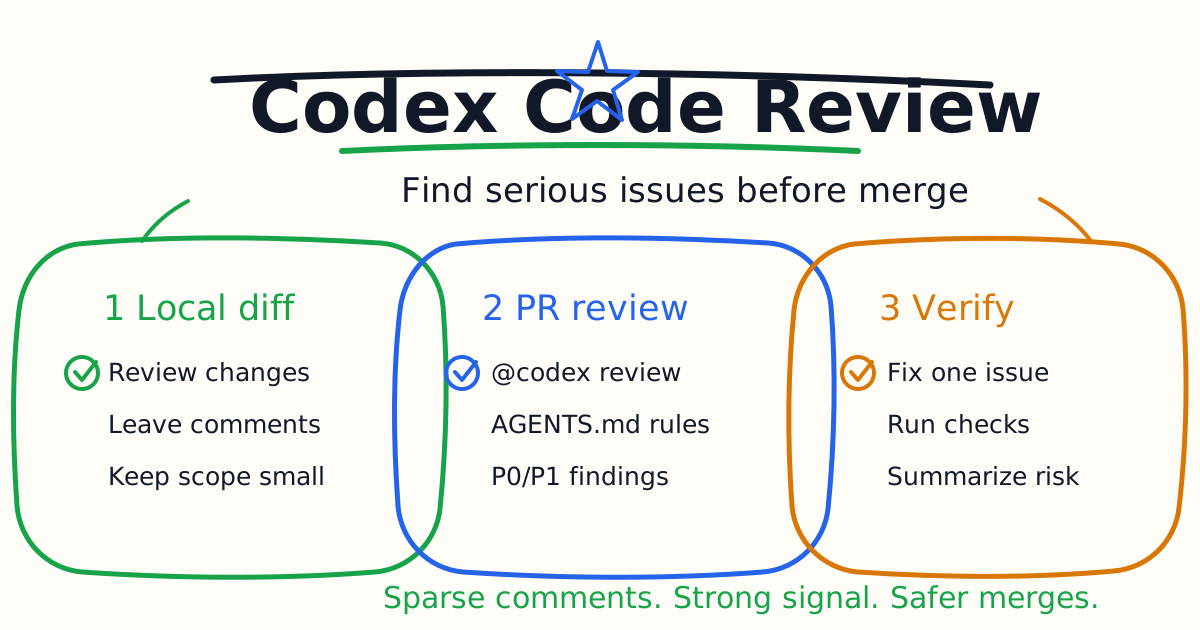
Codex is useful for writing code, but it can be just as valuable as a review partner. A good Codex review does not replace human judgment. It gives you another focused pass over the diff, catches serious risks earlier, and turns vague "looks good" review into a more concrete engineering checklist.
This tutorial covers the practical Codex review workflow: reviewing local changes, using the Codex app review pane, adding line-specific feedback, setting AGENTS.md review guidelines, and using Codex code review on GitHub pull requests.
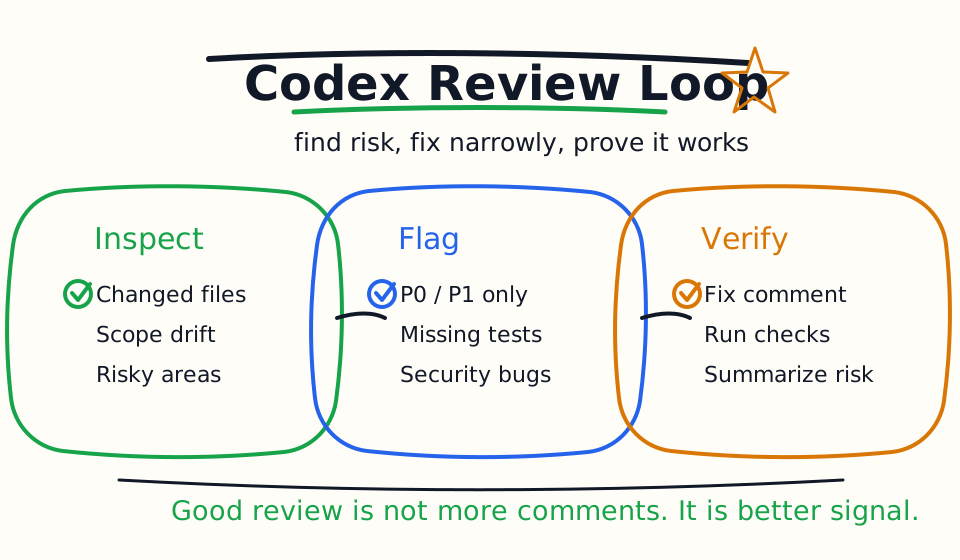
Quick Answer
Use Codex for code review when you have a real diff and a clear review goal. Ask it to look for correctness bugs, security regressions, missing tests, risky edge cases, and violations of project rules. Keep review comments sparse. A review assistant that floods a pull request with style opinions trains developers to ignore it.
For a local diff, ask:
Review my uncommitted changes for correctness bugs, missing tests, security risks, and unintended behavior changes. Prioritize only issues that would matter before merge.
For a GitHub pull request, use Codex review features when the repository has the required Codex cloud and GitHub setup. Add review guidelines to AGENTS.md so Codex understands what your team considers high priority.
What Codex Review Is Good At
Codex review is strongest when the question is concrete. It can inspect changed files, compare behavior before and after a patch, reason about edge cases, and suggest narrow fixes. It is especially useful for:
- Missing validation.
- Auth or permission regressions.
- Data loss risks.
- Broken loading or error states.
- Tests that no longer match behavior.
- API contract mismatches.
- Unsafe logging of sensitive data.
- Unintended changes outside the task scope.
It is weaker when the goal is vague, such as "make this better." Review needs a target. Tell Codex what kind of risk matters for the diff.
Review A Local Diff
Start with a clean mental boundary: what changed, why it changed, and what would make the change unsafe.
Use this prompt:
Review my current uncommitted changes.

Focus on:
1. Correctness bugs.
2. Security or privacy regressions.
3. Missing tests.
4. Behavior changes outside the stated goal.
5. Any file that should not have been touched.

Ignore pure style comments unless they hide a real bug.
Return findings first, ordered by severity, with file and line references when possible.
This prompt makes Codex behave like a serious reviewer instead of a style bot. The "ignore pure style" line matters because formatters and linters already handle many style concerns.
Use The Codex App Review Pane
OpenAI's Codex app review documentation describes a review pane that reflects the Git repository state. It can show uncommitted changes, all branch changes, or the most recent assistant turn. That is useful because a real diff may include both Codex edits and human edits.
Use the review pane for three jobs:
- Understand exactly which files changed.
- Leave targeted inline comments on specific lines.
- Stage or discard parts of the diff when you are shaping a commit.
Inline comments are especially useful. A general message like "fix this" often creates ambiguity. A line-specific comment such as "This route now accepts unauthenticated requests; preserve the existing middleware" gives Codex a precise repair target.
After leaving comments, send a follow-up message:
Address the inline comments only. Keep the diff minimal and run the closest related test.
That keeps the fix loop narrow.
Use AGENTS.md For Review Guidelines
Repository review standards should not live only in one prompt. Put durable review guidance in AGENTS.md.
Example:
## Review guidelines

- Prioritize P0/P1 issues: correctness, security, data loss, auth bypass, privacy, broken tests.
- Do not comment on formatting that lint already enforces.
- Verify that new API routes preserve authentication, rate limits, and error handling.
- Check that UI changes include loading, empty, and error states.
- Flag any logging of tokens, PII, payment data, or private user content.
This helps Codex review pull requests the way your team wants them reviewed. If one package has different risks, place a more specific AGENTS.md or AGENTS.override.md closer to that code.
Use Codex Review On GitHub Pull Requests
OpenAI's Codex GitHub review documentation describes a pull request review flow where Codex can review a PR diff, follow repository guidance, and post a standard GitHub code review. The setup requires Codex cloud for the repository and code review settings enabled.
The common manual trigger is:
@codex review
You can also focus the review:
@codex review for security regressions and missing tests
The important habit is to keep the request precise. If the PR changes authentication, ask for auth review. If it changes billing, ask for billing and data integrity review. If it changes UI state, ask for error, loading, and accessibility review.
Act On Findings
After Codex posts review findings, do not accept them blindly. Treat each finding like a teammate comment.
For every issue, decide:
- Is the finding valid?
- Is the severity correct?
- Is the proposed fix the smallest safe fix?
- Is there a test or check that proves the fix?
- Does the fix create a new risk?
If the finding is valid, ask Codex to address only that issue:
Fix the P1 issue about unauthenticated access. Keep the scope minimal, preserve existing route behavior, and run the related auth test.
If the finding is wrong, capture why. A false positive may mean the review guideline needs to be more specific, or the code needs a clearer test or comment.
Review Severity: What Deserves Attention
Use severity to protect attention.
| Severity | Use It For |
|---|---|
| P0 | Data loss, auth bypass, payment breakage, severe security issue |
| P1 | Real correctness bug, privacy leak, missing critical test, production regression |
| P2 | Maintainability issue that is likely to cause future bugs |
| P3 | Optional cleanup, naming, formatting, small readability preference |
Codex review is most valuable when it focuses on P0 and P1 issues. If a tool comments heavily on P3 issues, the team will stop reading.
A Practical Review Checklist
Use this checklist for every Codex-assisted review:
- Does the diff match the stated goal?
- Did any unrelated files change?
- Are risky areas touched: auth, billing, user data, deletion, deployment, migrations?
- Are new states tested: success, failure, empty, loading, retry?
- Does the change preserve public APIs?
- Does the error path behave correctly?
- Are secrets, tokens, PII, or provider payloads logged?
- Did verification run, and does the command actually cover the change?
This checklist turns Codex from a general opinion engine into a structured review assistant.
Common Mistakes
The first mistake is asking Codex to review too broadly. "Review this repo" is much weaker than "review this diff for auth regressions and missing tests."
The second mistake is accepting every suggestion. Codex can be wrong. Human review still owns the decision to merge.
The third mistake is letting style comments dominate. If formatting is the issue, use a formatter. Use Codex for behavioral risk.
The fourth mistake is fixing a review finding without verification. A review loop is not done until the related test, type check, build, or manual check supports the fix.
The fifth mistake is forgetting project guidance. Put durable review rules in AGENTS.md so Codex does not need the same reminder every PR.
Bottom Line
Codex review is most useful when it is focused, sparse, and evidence-driven. Ask it to find serious risks, not to rewrite the code. Use the review pane for local diffs, use AGENTS.md for durable review standards, and use GitHub review when your PR workflow is ready.
The goal is not more comments. The goal is fewer missed bugs, cleaner diffs, faster fixes, and reviewers who trust the signal.
Related Codex Tutorials
- Codex AGENTS.md Guide
- Codex Quick Start
- Codex CLI Tutorial
- Codex Prompts for Developers
- Codex MCP Guide
- Codex Cloud Tasks Guide
- Codex Exec Automation Guide
- Codex GitHub Action Tutorial
- Codex Permissions and Sandbox Guide
- Codex Image Input Guide
- AI Code Review Tools Evaluation Guide
Official References
Decision Checklist For Codex Code Review Tutorial
Use this guide as a decision filter before a sales call, trial, or migration plan. For Codex Code Review Tutorial, the practical question is whether the topic connects Codex code review, Codex review, AI code review to a measurable workflow outcome. A good decision should improve delivery speed, quality, cost control, or operational confidence without creating hidden review, security, or migration work.
- Generated changes survive code review with fewer rewrites, fewer broad diffs, and fewer style corrections.
- The assistant understands multi-file context, tests, build failures, private repository rules, and local conventions.
- Administrators can manage seats, data controls, policy settings, and usage visibility without blocking developers.
Pilot Plan
A useful pilot is small enough to finish quickly but realistic enough to expose integration, data, workflow, and pricing issues. Avoid demo-only tests. The trial should use real tasks, real constraints, and a baseline from the current process so the team can decide with evidence instead of impressions.
- Give each candidate the same bug fix, failing-test repair, refactor, and explanation task.
- Track accepted diffs, reviewer comments, rework time, test pass rate, and developer satisfaction.
- Run the trial with senior maintainers and newer engineers because the value pattern is different for each group.
Metrics To Track
Track metrics that connect Codex Code Review Tutorial to outcomes a budget owner and an engineering owner can both understand. A tool can look impressive in a demo and still fail if usage is low, quality is uneven, or the cost model changes under real workload volume.
- Accepted AI-assisted diffs, rejected suggestions, reviewer comments, and post-merge fixes.
- Time to repair failing tests, explain unfamiliar modules, and complete safe refactors.
- Seat utilization, premium request exhaustion, and policy exceptions for sensitive repositories.
Budget And Risk Review
Commercially useful AI tooling decisions should include the subscription or API price, but they should also include support load, review time, observability, privacy controls, switching cost, and the cost of wrong or low-quality output. Treat the first estimate as a working model and update it with production evidence.
- Confirm private code handling, training opt-out, data retention, and enterprise policy controls.
- Watch for over-generation: large patches that look productive but increase review cost.
- Compare cost per accepted change rather than cost per seat alone.
Revisit the assistant after 30 days of real pull requests. A useful coding tool should reduce review latency and onboarding friction without increasing risky generated code.
Editorial note
AI Jupyter writes independent guides for technical readers. Product details, pricing, and feature names can change, so readers should verify commercial terms on the official vendor site before buying.
Reviewed by the AI Jupyter Editorial Team.