
AI Coding Tools
Codex IDE Extension Tutorial
A practical Codex IDE extension tutorial for VS Code, Cursor, Windsurf, editor context, approval modes, cloud delegation, and review workflows.
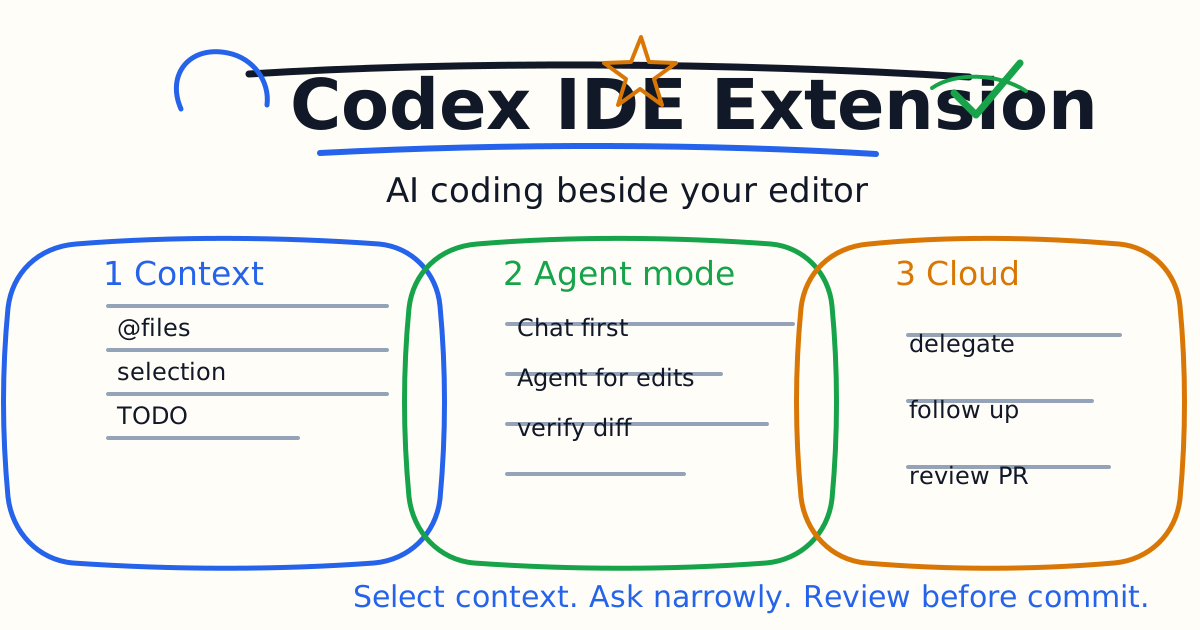
The Codex IDE extension brings OpenAI Codex into VS Code and VS Code-compatible editors such as Cursor and Windsurf. It lets you chat with Codex beside your code, add selected files as context, ask for focused edits, switch models and reasoning effort, run local tasks, or delegate larger work to Codex Cloud.
This tutorial explains the practical setup: how to use editor context, when to choose Chat versus Agent mode, how to keep approvals safe, how to use slash commands, and how to decide when a task should stay local or move to the cloud.
Quick Answer
Use the Codex IDE extension when the task depends on what you are looking at in the editor: a selected function, an open file, a task comment, a failing component, or a narrow refactor. Use @filename references and selected code instead of pasting large context into the chat.
Start in Chat mode when you want explanation or planning. Use Agent mode when you want Codex to read files, edit code, and run commands in the workspace. Use Agent Full Access only when you understand the network and filesystem risk. For large jobs, use cloud delegation after the repository has a working Codex cloud environment.
What The IDE Extension Is For
The IDE extension is for editor-attached coding. It is different from the terminal-first Codex CLI Tutorial because it sits next to the file you are editing. You can point Codex at a selection, a file, or a visible problem without describing the whole repository from scratch.
Use the IDE extension for:
- Explaining selected code.
- Fixing a small bug in the file you are editing.
- Implementing a task comment.
- Refactoring one component or helper.
- Writing nearby tests.
- Reviewing uncommitted changes.
- Moving a larger task to cloud once local context is clear.
Use the Codex CLI instead when you are already working from the terminal. Use the Codex app when you want a broader desktop workflow with worktrees, browser checks, automations, or multiple parallel threads.
Install And Sign In
Install the Codex extension in your editor, then sign in with your ChatGPT account or an OpenAI API key. ChatGPT Plus, Pro, Business, Edu, and Enterprise plans include Codex access, but feature availability can differ by account and workspace policy.
In VS Code, Codex appears in the sidebar. In VS Code forks such as Cursor, you may need to move the Codex icon to the right sidebar manually if you want it beside the native editor chat.
After sign-in, open a real project folder rather than a single loose file. Codex works best when it can see repository structure, package scripts, tests, and project guidance such as AGENTS.md.
Add Context The Right Way
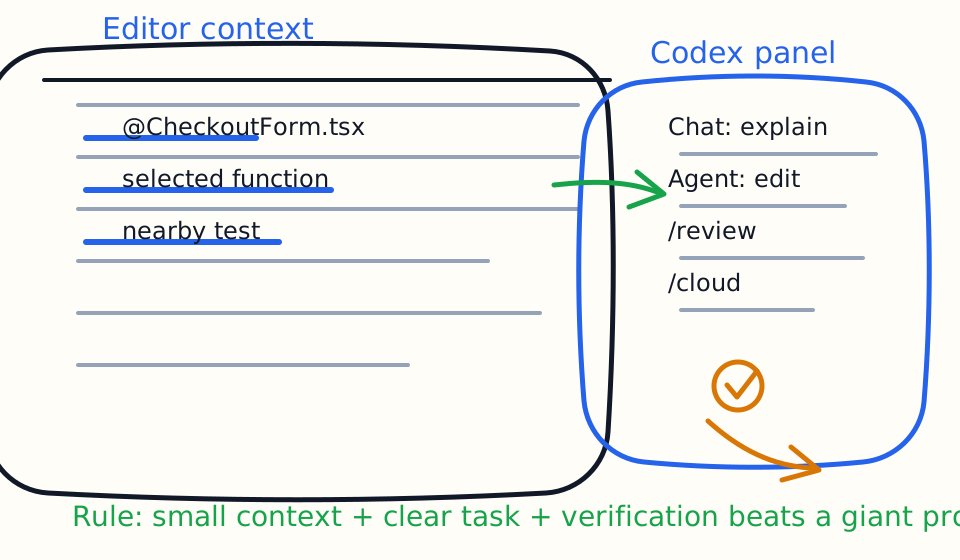
The biggest IDE advantage is context control. Instead of writing a long prompt, point Codex at the exact file or selection.
Examples:
Use @CheckoutForm.tsx and @pricing.ts as context. Find why the annual price is rendered incorrectly and patch only the smallest related code.
Explain the selected function. Focus on inputs, side effects, and the easiest test to add.
Use @api/users/route.ts as the reference style. Add pagination to @api/projects/route.ts and run the closest test.
Good IDE prompts are short because the editor supplies the missing context. Bad prompts ask Codex to infer too much from the entire repo.
Choose Chat, Agent, Or Full Access
The IDE extension supports different operating modes. Treat them as permission levels, not personality modes.
Use Chat when:
- You want an explanation.
- You want a plan before edits.
- You are exploring unfamiliar code.
- You are asking about tradeoffs.
Use Agent when:
- You want Codex to edit files.
- You want Codex to run tests or build commands.
- The work stays inside the current workspace.
- You can review the diff before committing.
Use Agent Full Access only for controlled situations where network access or broader command access is genuinely needed. If a task only needs local files and package scripts, keep the default approval boundary.
For a deeper permission model, see the Codex Permissions and Sandbox Guide.
Model And Reasoning Settings
The extension lets you switch models and reasoning effort from the chat input area. A simple rule works well:
- Start with medium reasoning.
- Use low for quick explanations and mechanical edits.
- Use high for multi-file debugging, architecture work, migration planning, or security-sensitive review.
Higher reasoning effort can improve complex work, but it may take longer and use more tokens. Do not turn every small edit into a high-effort task. Save it for work where deeper reasoning changes the outcome.
Useful Command Palette Actions
The official IDE command list includes actions for adding selected text to a thread, adding a whole file, creating a new chat, implementing a task comment, creating a new Codex panel, and opening the sidebar.
Practical uses:
- Select a confusing function and add it to the current thread.
- Add a whole file when the selected snippet depends on file-level constants.
- Use a new chat for a new task so context does not drift.
- Use the task-comment action when the code already describes the desired change.
- Bind the commands you use daily to keyboard shortcuts.
The goal is not to use every command. The goal is to make context handoff faster and cleaner than copy-paste.
Slash Commands
Slash commands let you control Codex from the composer. Useful commands include /status, /review, /cloud, /cloud-environment, /local, /auto-context, and /feedback.
Use /status when you want to see the thread and rate-limit state. Use /review when your current goal is to inspect a diff rather than write new code. Use /cloud only when the cloud environment is ready enough to run the task without manual setup.
If your workspace enables persistent goals, /goal can keep Codex oriented across turns. That is useful for long content or engineering programs, but the goal should still be concrete and verifiable.
A Good First IDE Task
Do not start with "refactor the whole app." Start with a visible, bounded task:
Use the current file and @Button.tsx. Fix the disabled loading state so the button keeps the same width, then run the closest component test. Do not change colors or copy.
This prompt works because it includes:
- Context.
- A specific bug.
- A design constraint.
- A verification command.
- A review boundary.
For more reusable prompt patterns, see Codex Prompts for Developers.
Local Versus Cloud
Stay local when the task depends on your current editor state, local services, screenshots, or fast interactive review.
Move to cloud when the task is larger, parallel, or does not require your local machine. The IDE extension can delegate to Codex Cloud after you choose a cloud environment. You can start from main for a new idea or from local changes when you want Codex to continue work you already shaped.
Before using cloud delegation heavily, set up the environment. See the Codex Cloud Environment Setup Guide for setup scripts, secrets, cache behavior, and network access.
Review Before You Commit
The IDE extension makes it easy to accept generated code too quickly because the changes appear in the same editor where you normally work. Slow down at the review step.
Check:
- Did Codex edit only the intended files?
- Did it preserve existing patterns?
- Did it run the right test or explain why it could not?
- Did it add broad abstractions for a narrow problem?
- Did generated copy, comments, or docs introduce stale product claims?
Use Codex Code Review Tutorial when the task is specifically to review a diff.
Common Mistakes
The first mistake is sending the entire repository as context when one file and one test would be enough. More context can make the task slower and less focused.
The second mistake is using Agent Full Access because it feels convenient. Most IDE tasks do not need broad network or filesystem access.
The third mistake is mixing multiple goals in one thread: explain the repo, redesign the UI, fix auth, and write docs. Split those into separate tasks.
The fourth mistake is accepting a patch without running the local verification command. Codex can be strong, but your build and tests are still the contract.
Best Workflow
Use the IDE extension as your fast local coding partner:
- Open the relevant file.
- Select the smallest useful context.
- Ask for one narrow outcome.
- Let Agent mode edit when edits are needed.
- Run or request verification.
- Review the diff.
- Delegate to cloud only when the cloud environment is ready.
That rhythm keeps Codex close to your editor without turning the editor into an uncontrolled automation surface.
Related Codex Tutorials
- Codex Quick Start
- Codex CLI Tutorial
- Codex Prompts for Developers
- Codex Cloud Environment Setup Guide
- Codex Cloud Tasks Guide
- Codex Permissions and Sandbox Guide
- Codex Code Review Tutorial
- Codex vs Claude Code
- Claude Code Quick Start
- Claude Code CLI Tutorial
- Claude Code VS Code Tutorial
Official References
Decision Checklist For Codex IDE Extension Tutorial
Use this guide as a decision filter before a sales call, trial, or migration plan. For Codex IDE Extension Tutorial, the practical question is whether the topic connects Codex IDE extension, VS Code AI agent, Cursor Codex to a measurable workflow outcome. A good decision should improve delivery speed, quality, cost control, or operational confidence without creating hidden review, security, or migration work.
- Generated changes survive code review with fewer rewrites, fewer broad diffs, and fewer style corrections.
- The assistant understands multi-file context, tests, build failures, private repository rules, and local conventions.
- Administrators can manage seats, data controls, policy settings, and usage visibility without blocking developers.
Pilot Plan
A useful pilot is small enough to finish quickly but realistic enough to expose integration, data, workflow, and pricing issues. Avoid demo-only tests. The trial should use real tasks, real constraints, and a baseline from the current process so the team can decide with evidence instead of impressions.
- Give each candidate the same bug fix, failing-test repair, refactor, and explanation task.
- Track accepted diffs, reviewer comments, rework time, test pass rate, and developer satisfaction.
- Run the trial with senior maintainers and newer engineers because the value pattern is different for each group.
Metrics To Track
Track metrics that connect Codex IDE Extension Tutorial to outcomes a budget owner and an engineering owner can both understand. A tool can look impressive in a demo and still fail if usage is low, quality is uneven, or the cost model changes under real workload volume.
- Accepted AI-assisted diffs, rejected suggestions, reviewer comments, and post-merge fixes.
- Time to repair failing tests, explain unfamiliar modules, and complete safe refactors.
- Seat utilization, premium request exhaustion, and policy exceptions for sensitive repositories.
Budget And Risk Review
Commercially useful AI tooling decisions should include the subscription or API price, but they should also include support load, review time, observability, privacy controls, switching cost, and the cost of wrong or low-quality output. Treat the first estimate as a working model and update it with production evidence.
- Confirm private code handling, training opt-out, data retention, and enterprise policy controls.
- Watch for over-generation: large patches that look productive but increase review cost.
- Compare cost per accepted change rather than cost per seat alone.
Revisit the assistant after 30 days of real pull requests. A useful coding tool should reduce review latency and onboarding friction without increasing risky generated code.
Editorial note
AI Jupyter writes independent guides for technical readers. Product details, pricing, and feature names can change, so readers should verify commercial terms on the official vendor site before buying.
Reviewed by the AI Jupyter Editorial Team.