
AI Coding Tools
Codex vs Claude Code
A practical Codex vs Claude Code comparison for developers choosing an AI coding agent in 2026.
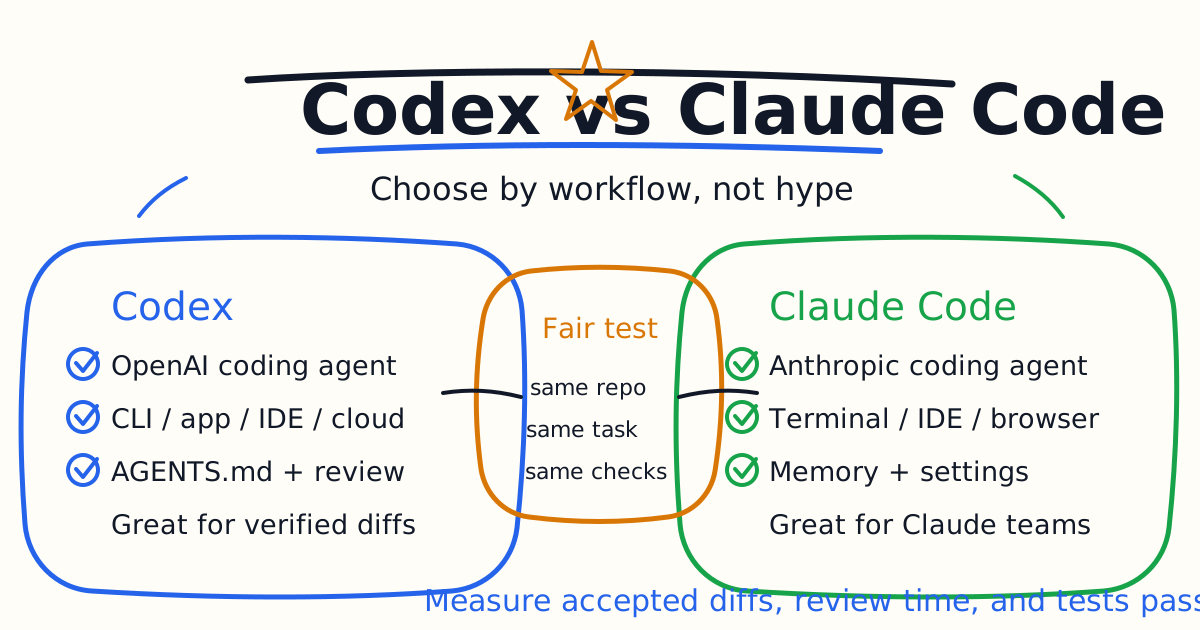
The old AI coding debate was mostly about autocomplete. Developers compared Cursor, GitHub Copilot, and Windsurf by asking which tool wrote the next function faster. That question is no longer enough. The valuable comparison in 2026 is between agentic coding workflows: can the tool understand a real repository, edit multiple files, run checks, follow project rules, and help you review the final diff?
That is why developers are now comparing Codex and Claude Code. Codex is OpenAI's coding agent, available across surfaces such as the Codex CLI, IDE extension, app, and cloud workflows. Claude Code is Anthropic's agentic coding tool that can read a codebase, edit files, run commands, and integrate with developer tools. Both are serious tools. The right choice depends less on brand loyalty and more on the work you want the agent to do.
Quick Answer
Choose Codex if you want an OpenAI-centered coding agent workflow with strong support for Codex CLI, Codex app review, project instructions through AGENTS.md, image inputs, local and cloud tasks, and a workflow that pairs naturally with ChatGPT and OpenAI developer tooling.
Choose Claude Code if your team is already standardized on Claude, wants Anthropic's terminal and IDE agent workflow, likes Claude Code memory and settings conventions, or wants to use Claude Code's documented workflows for repository exploration, bug fixing, refactoring, testing, pull requests, and documentation.
Do not choose by reading one benchmark screenshot. Run the same five repository tasks in both tools, require the same constraints, and measure the accepted diff rate, time to review, tests passed, and number of corrections needed.
What Codex Is Best For
Codex is strongest when you want an AI coding agent that behaves like a configured teammate. The practical workflow is simple: open a repository, give Codex a focused task, let it inspect context, allow it to edit files, ask it to run the relevant check, and review the final diff.
The OpenAI Codex documentation emphasizes using Codex across different surfaces. The CLI is a fast path for terminal-first work. The IDE extension is useful when you want Codex near your editor. The Codex app is helpful for review, planning, browser-backed checks, and richer desktop sessions. Cloud tasks can offload longer or parallel work once the repository is available in the cloud environment.
Codex also has a clean project instruction story. AGENTS.md lets a repository describe setup commands, style rules, test instructions, and project-specific constraints. That matters because coding agents do better when they do not need to rediscover the same rules every session. A good AGENTS.md turns repeated reminders into shared project memory.
Use Codex when your first priority is a repeatable OpenAI coding workflow: prompt structure, repository context, verification, diff review, local automation, and team instructions.
What Claude Code Is Best For
Claude Code is strongest when your development workflow already fits Anthropic's agent model. Anthropic describes Claude Code as an agentic coding tool that can read your codebase, edit files, run commands, and work through developer surfaces such as terminal, IDE, desktop app, and browser.
The official Claude Code docs provide a lot of workflow material: exploring unfamiliar codebases, fixing bugs, refactoring, writing tests, creating pull requests, updating documentation, and resuming conversations. That makes Claude Code attractive for teams that want a documented, Claude-native operating model rather than a generic chatbot flow.
Claude Code also has useful conventions around memory and settings. Its memory system can store project and workflow context, and settings can control behavior such as permissions, hooks, and environment-level configuration. If your team likes explicit configuration files and a Claude-centered workflow, Claude Code may feel natural.
Use Claude Code when your first priority is Anthropic's coding agent environment, Claude-native terminal work, documented codebase workflows, and project memory patterns.
Side-By-Side Comparison
| Question | Codex | Claude Code |
|---|---|---|
| Best first use case | Fix one bug, explain one module, review one diff, add one test | Explore a repo, fix a bug, refactor a narrow path, generate tests |
| Primary ecosystem | OpenAI, ChatGPT, Codex CLI, Codex app, IDE, cloud tasks | Anthropic, Claude Code terminal, IDE, desktop app, browser |
| Project instructions | AGENTS.md for setup, rules, tests, and nested project guidance | Memory and settings files for project context and behavior |
| Review workflow | Codex app review, CLI review, diff summaries, verification prompts | PR and issue workflows, GitHub Actions integration, review assistance |
| Best prompt style | Goal, context, constraints, done condition | Clear task, relevant files, constraints, verification request |
| Risk control | Keep scope small, run checks, review diff, document project rules | Configure permissions/settings, run tests, inspect changes, review output |
This table is not a ranking. It is a workflow map. A tool that feels excellent in a solo repository can be a poor fit for a team if it ignores review habits, security boundaries, or existing CI. A tool that feels slower on one task can be better for your team if it produces easier diffs to review.
The Fair Test: Five Tasks In One Repository
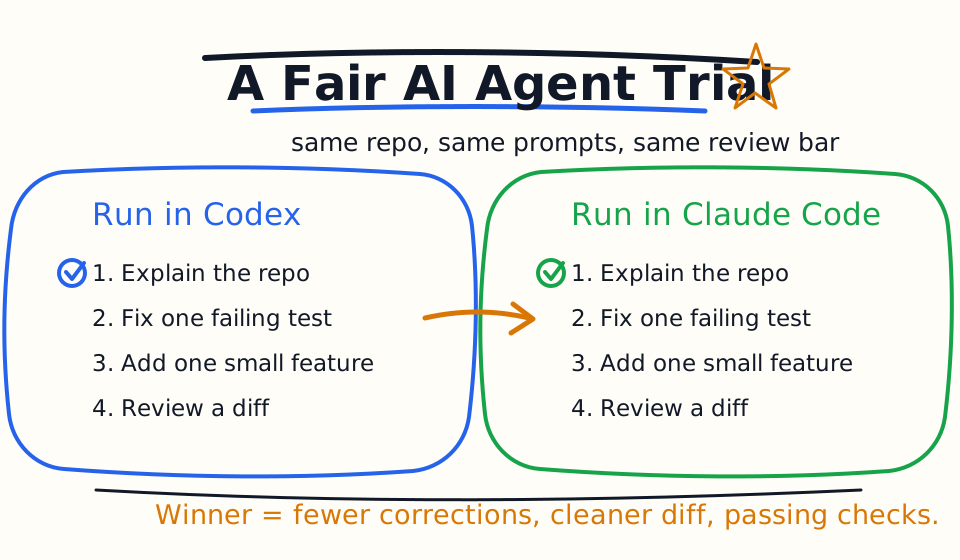
The best Codex vs Claude Code comparison is a controlled pilot. Pick one active repository. Run the same tasks in both tools. Use the same prompt structure. Require the same verification. Review the results without giving one tool more context than the other.
Use these five tasks:
- Explain the repository structure and identify the safest first improvement.
- Fix one failing test without rewriting the module.
- Add one validation rule and update the closest related test.
- Review one existing pull request or local diff for bugs and missing tests.
- Improve one documentation page using package scripts as source of truth.
For every task, record four numbers: time to first useful plan, number of files changed, verification result, and number of reviewer corrections. The winner is not the tool that writes the most code. The winner is the tool that helps you accept the smallest correct diff with the least review friction.
Prompt Template For A Fair Trial
Use the same structure for both tools:
Goal: Fix the failing password reset test.

Context: Start from the test output below and inspect only the related auth files first.

Constraints: Make the smallest necessary fix. Do not change public API names. Do not add a dependency.

Done when: The related test passes, and you summarize the changed files, verification result, and remaining risk.
This prompt works because it avoids two common comparison mistakes. It does not ask the agent to "improve the codebase" in a vague way, and it does not reward broad rewrites. A useful coding agent should narrow the problem, make a focused edit, and prove the result.
When Codex Is The Better Starting Point
Start with Codex if you already use ChatGPT heavily, want OpenAI's Codex surfaces, or care about AGENTS.md as a simple repository instruction file. Codex is also a strong starting point if you want one workflow that moves from local CLI work to app-based review and cloud tasks.
Codex is especially useful for teams that want to document agent behavior inside the repository. Put setup steps, package manager rules, lint commands, test commands, and review constraints in AGENTS.md. Then your Codex sessions start with the same project instructions instead of relying on memory from a previous chat.
Codex is also appealing when image input matters. For example, you can show Codex a screenshot of a broken mobile layout, ask it to find the likely component, patch the CSS, and verify that horizontal overflow is gone. That turns visual QA into a practical coding task.
When Claude Code Is The Better Starting Point
Start with Claude Code if your team already uses Claude for technical reasoning and wants a coding agent that follows Anthropic's tooling and documentation. Claude Code's docs are especially useful for teams that want a ready-made set of workflows around codebase exploration, bug fixing, refactoring, testing, pull requests, and documentation.
Claude Code can also be a good fit when memory and settings conventions matter. If you want project or local workflow context to be managed through Claude Code's own memory and settings model, its official docs give you a clear path.
Claude Code also has documented GitHub workflows. If your team wants to invoke an agent from issues or pull requests and use automatic review patterns, include those workflows in your pilot instead of only testing local terminal tasks.
Common Mistakes
The first mistake is comparing one perfect demo from one tool against a rushed test from the other. A fair comparison uses the same repo, same task, same constraints, and same review standard.
The second mistake is rewarding large diffs. Agentic coding is valuable when it reduces human review cost. A smaller correct patch is usually better than a larger patch that appears impressive but takes longer to audit.
The third mistake is skipping verification. If neither tool runs the relevant test, build, type check, or lint command, you are comparing writing style rather than engineering usefulness.
The fourth mistake is ignoring team controls. Repository instructions, memory, settings, permissions, secrets, CI, and review rules matter more than a single answer quality screenshot.
Bottom Line
Codex and Claude Code are both modern AI coding agents. The right question is not "which one is universally better?" The right question is "which one helps my team produce smaller, safer, verified diffs in our real repository?"
Start with a five-task pilot. Use the same prompts. Require verification. Review every diff. If Codex fits your OpenAI workflow and repository instruction style, build your process around it. If Claude Code fits your Anthropic workflow, memory model, and GitHub automation needs, standardize there. The best AI coding tool is the one that improves your real development loop.
Related AI Coding Agent Tutorials
- Codex Quick Start
- Codex CLI Tutorial
- Codex IDE Extension Tutorial
- Codex Prompts for Developers
- Codex AGENTS.md Guide
- Codex MCP Guide
- Codex Cloud Tasks Guide
- Codex Cloud Environment Setup Guide
- Codex Exec Automation Guide
- Codex GitHub Action Tutorial
- Codex Permissions and Sandbox Guide
- Codex Image Input Guide
- Codex Code Review Tutorial
- Claude Code Quick Start
- Claude Code CLI Tutorial
- Claude Code Settings and Memory Guide
- Claude Code VS Code Tutorial
- Claude Code GitHub Actions Guide
- Claude Code MCP Guide
- Claude Code Hooks Guide
- Claude Code Subagents Guide
- Claude Code Skills and Slash Commands Guide
- Claude Code Plugins Guide
- Claude Code Agent Teams Guide
Official References
- OpenAI Codex quickstart
- Codex CLI features
- Codex prompting guide
- Custom instructions with AGENTS.md
- Codex review workflow
- Claude Code overview
- Claude Code quickstart
- Claude Code common workflows
- Claude Code CLI reference
- Claude Code memory
- Claude Code settings
- Claude Code GitHub Actions
- Claude Code in VS Code
Decision Checklist For Codex vs Claude Code
Use this guide as a decision filter before a sales call, trial, or migration plan. For Codex vs Claude Code, the practical question is whether the topic connects Codex vs Claude Code, Codex tutorial, Claude Code tutorial to a measurable workflow outcome. A good decision should improve delivery speed, quality, cost control, or operational confidence without creating hidden review, security, or migration work.
- Generated changes survive code review with fewer rewrites, fewer broad diffs, and fewer style corrections.
- The assistant understands multi-file context, tests, build failures, private repository rules, and local conventions.
- Administrators can manage seats, data controls, policy settings, and usage visibility without blocking developers.
Pilot Plan
A useful pilot is small enough to finish quickly but realistic enough to expose integration, data, workflow, and pricing issues. Avoid demo-only tests. The trial should use real tasks, real constraints, and a baseline from the current process so the team can decide with evidence instead of impressions.
- Give each candidate the same bug fix, failing-test repair, refactor, and explanation task.
- Track accepted diffs, reviewer comments, rework time, test pass rate, and developer satisfaction.
- Run the trial with senior maintainers and newer engineers because the value pattern is different for each group.
Metrics To Track
Track metrics that connect Codex vs Claude Code to outcomes a budget owner and an engineering owner can both understand. A tool can look impressive in a demo and still fail if usage is low, quality is uneven, or the cost model changes under real workload volume.
- Accepted AI-assisted diffs, rejected suggestions, reviewer comments, and post-merge fixes.
- Time to repair failing tests, explain unfamiliar modules, and complete safe refactors.
- Seat utilization, premium request exhaustion, and policy exceptions for sensitive repositories.
Budget And Risk Review
Commercially useful AI tooling decisions should include the subscription or API price, but they should also include support load, review time, observability, privacy controls, switching cost, and the cost of wrong or low-quality output. Treat the first estimate as a working model and update it with production evidence.
- Confirm private code handling, training opt-out, data retention, and enterprise policy controls.
- Watch for over-generation: large patches that look productive but increase review cost.
- Compare cost per accepted change rather than cost per seat alone.
Revisit the assistant after 30 days of real pull requests. A useful coding tool should reduce review latency and onboarding friction without increasing risky generated code.
Editorial note
AI Jupyter writes independent guides for technical readers. Product details, pricing, and feature names can change, so readers should verify commercial terms on the official vendor site before buying.
Reviewed by the AI Jupyter Editorial Team.